
The Weblog

January 2008 Archives

Shell Oil Hints At Peak Oil

| 1 Comment

This (via The Oil Drum) is noteworthy. In a recently-released statement, Royal Dutch Shell's CEO all but admitted that the world is on the verge of peak oil prodution (emphasis added):

Regardless of which route we choose, the world's current predicament limits our room to maneuver. We are experiencing a step-change in the growth rate of energy demand due to rising population and economic development. After 2015, easily accessible supplies of oil and gas probably will no longer keep up with demand.

As a result, we will have no choice but to add other sources of energy - renewables, yes, but also more nuclear power and unconventional fossil fuels such as oil sands.

It's remarkable that a major energy company is publicly acknowledging that within seven years we will no longer be able to draw from "easily accessible"--i.e., "cheap"--reserves of oil. Presumably we'll be stuck with drilling thousands of feet into the ocean or trying to squeeze oil out of sand. High demand for a resource + higher production costs = a much higher market price.

We now have energy company leaders talking about the upcoming oil supply crunch. Where is the political leadership on this issue?

Even the Democratic presidential candidates are missing in action. Sure they talk about more ethanol, changing light bulbs, and throwing up a few more windmills. But this problem calls for action far beyond that. We need to be restructuring our entire transportation system--placing a heavy emphasis on public transportation. We need to improve our rail infrastructure so that it will be better equipped to transport freight. We need to build or extend light (electric) rail transit systems in our major cities. We need to increase our nuclear power capacity.

In short, we need someone with leadership skills who can lead us in finding national solutions which may not necessarily be easy, convenient, or cheap. But which, over the long run, with help us navigate through the treacherous rapids of peak oil without capsizing.
Now On Facebook

By and large, I'm still mired in the 20th century. But curiosity got the best of me as I wanted to see one of these new-fangled social-networking sites that I've heard all the cool kids are into.

So I set up an account at Facebook. I'm still trying to figure out how everything works there. But it looks like a nice communication tool and a way to reconnect with long-lost friends.

Check it out if you're registered on the site.

Potpourri

  • Wind power generating capacity increased by 47% in 2007. A hopeful and impressive increase.
  • Fareed Zakaria on Iraq:
    The Democrats are having the hardest time with the new reality. Every candidate is committed to "ending the war" and bringing our troops back home. The trouble is, the war has largely ended, and precisely because our troops are in the middle of it.
    Hmm. It seems if the war "has largely ended," then we should be able to bring the troops home. No?
  • A story I wish some good journalists would get to the bottom of: this Sibel Edmonds matter. Where is the American news media? I think we can peel a few reporters off the missing white women beat and cover this.
  • Bill Gross:
    "It's a sad testament to think the Fed has to cut interest rates eight days in front of a meeting to salvage the equity markets," said Gross, the founder and chief investment officer of Pacific Investment Management Co., in a Bloomberg Television interview. "The U.S. economy is in a rather sad state of affairs in that it depends on housing and stock prices to keep going."
    Indeed, the biggest rate cut in a quarter century--triggered by an emergency meeting, no less. Bonddad has graphs illustrating that over the past six years, when interest rates have been at their lowest levels in 40 years, household debt has been souring. So the ultimate solution to this mess is to slash interest rates again?
  • A contrast in predictions:

    Merrill Lynch:

    Merrill Lynch forecasts nationwide U.S. home prices could decline 25% to 30% over the next three years, as new supply and weak demand weigh on the market. . . [David] Rosenberg added the S&P 500 may decline an additional 20% to 25% to breach the 1,100-point level if the market follows historical precedents at times when the U.S. economy is in recession.

    The Big Picture:
    Goldman Sachs' Abby Joseph Cohen chief U.S. portfolio strategist continues to forecast a Dow return of 11% by year-end. She sees the Dow at 14,750 by year-end (Briefing.com)
    I report, you decide.

Cold Cycling

Yesterday I went out for a bike ride. It was 24F when I finished--my coldest ride to date. In fact, it's the first ride I've done below 30F.

It was cold. Fortunately, the winds were fairly calm, or it would have been worse.

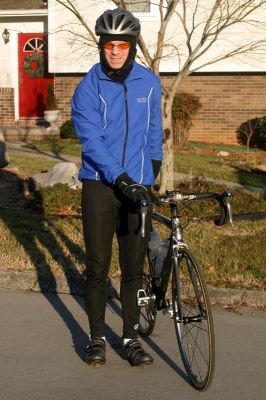
I survived 21 miles. Here's what I wore:

  • T-shirt

  • Gore (brand) windbreaker jacket

  • Performance (brand) windbreaker bib tights

  • Two pairs of socks

  • Plastic wrap on my feet

  • Blaclava

  • Warm gloves

  • Sunglasses

(File photo of me in my cold weather outfit)

Most of my body stayed warm enough; in fact, I sweat a little in the mid-section. My feet were the weak link. I started feeling them after about 20 minutes and they got worse as time went on. I think they would really have bothered me had I gone on a 30-mile ride.

I'm glad we rarely have such frigid conditions in East Tennessee. I wouldn't want to make a habit of that.

How much longer until spring?

It's going to interesting seeing how the right-wing noise machine spins Senator McCain's victory (and Governor Huckabee's second-place finish) in the South Carolina primary.

As I've noted before, there's a vocal block of the GOP media that can't stand McCain. That became even more apparent this past week:

  • Former House Majority Leader Tom DeLay: "McCain has done more to hurt the Republican party than any elected official I know of."

  • Rush Limbaugh (on McCain and Huckabee): "I'm here to tell you, if either of these two guys get the nomination, it's going to destroy the Republican Party, it's going to change it forever, be the end of it."
Today the GOP destroyers finished 1-2 in South Carolina. What gives?

Until now the McCain/Huckabee bashers had excuses to rationalize the two candidates' victories. Huckabee won Iowa because it's not a conservative Republican state. McCain won New Hampshire only because he had Democrats and independents crossing over to vote for him. In other words, neither won a contest of "real" Republican voters.

That case is now much harder to make. Although South Carolina does have an open primary, exit polling reveals that 80% of voters were Republican. More significantly, Huckabee (35%) and McCain (26%) finished first and second among self-identified conservative voters. The allegedly surging, conservative Fred Thompson failed to get 20%. So Huckabee and McCain have won the conservative vote in a conservative state.

So how will McCain's victory be spun? I imagine, like this:

Tonight, he got 33% of the vote in a field where his top challengers--Romney and Giuliani--aren't even running, and 135,000 actual votes. If just the same people who voted for McCain in 2000 had voted for him today, he would have won 50+% of the South Carolina vote. That would have been truly impressive.

Instead, John McCain LOST the support of 100,000 people--and he's the winner?

The problem for McCain haters is that Romney appears to be the only viable "conservative" (and I use that term loosely) remaining. Are they going to be able to mobilize support for a default candidate? We'll have a better answer after the Florida primary on January 29.

Vote For the Chameleon

| 5 Comments | 0 TrackBacks

There's something weird going on regarding the expectations of Governor Romney as a Republican party presidential nominee. On one hand you have people in the right-wing noise machine either explicitly or implicitly endorsing Romney as the most electable "conservative" candidate. [Apparently, McCain, Huckabee, and Guiliani are conservative enough, and they don't see Thompson ever getting off the ground.]

On one hand you have a number of Democratic activists urging Democrats to vote for Romney, because they think Romney's continued presence in the race will spawn Republican turmoil. Embedded in that view, however, is the assumption that Romney is either (1) not a significant threat to win the White House, or (2) a more acceptable GOP candidate that the other contenders.

So we've apparently got Republicans supporting Romney due to his political viability at the same time we've got Democrats routing for Romney because they think he is unelectable. Someone is misreading him.

I guess this shouldn't come as much of a surprise. One of Romney's talents seems to be his ability cast his image differently depending on which audience he's playing to.

For now that's the conservative base. Should he win the GOP nomination, will he change his colors again and moderate his stances again? It beats me.

Due to this uncertainty, I don't know what to make of Romney as a potential president. Moreover, apart from his flip flopping, I'm disturbed by Romney's ability to make ridiculous statements with a straight face. Take this from a recent campaign advertisement:

Like his latest ad in Iowa, the new Granite State ad is positive, and it is more forward-looking than other Romney ads.

"No one votes for yesterday," Romney says in the spot. "We vote for tomorrow. Every election is about the future. Many are pessimistic. I'm not. In the next ten years, we'll see more progress, more change than the world has seen in the last ten centuries.

"Our next president must unleash the promise and innovation of the American people," he continues. "I'm ready for the challenge. The future begins now."

More change in the next 10 years than there was in the last 1,000 years? That's absurd. In essence Romney is claiming that a person today would better relate to life in 1008 AD than he or she will with life in 2018 AD.

What's odd is that Romney doesn't need to make bizarre claims like this, or marching with ML King, Jr. or being a "lifelong hunter"--he could simply run on his record. But for some reason he's compelled to go over the top to make a sell. That characteristic doesn't fly for someone aspiring to stand on the world's premier soapbox.

Is The Surge Working?

| 7 Comments | 0 TrackBacks

The one-year anniversary of the announcement of the surge in Iraq has renewed the debate on whether or not the military escalation is "working." On one hand, war supporters claim it is a success because violence is down from its peak in 2006. On the other hand, war opponents declare it has failed because Iraq has not made significant progress toward political stability. In the middle, you've got the news media who doesn't offer much insight into to what is happening in Iraq beyond reporting American casualties.

So, what do we make of the conflicting claims? I have a simple rule to assess military success:

The American military will have accomplished its ultimate objective when it can

  • substantially leave Iraq (less than 30,000 troops remaining), without
  • the country descending into violence or chaos

Until that happens, all we are doing is adjusting the occupation strategy.

From all appearances, we are still years away from the surge bringing about "success" in Iraq.

UPDATE: Here we go:

The Iraqi defense minister said Monday that his nation would not be able to take full responsibility for its internal security until 2012, nor be able on its own to defend Iraq's borders from external threat until at least 2018.
. . .
Pentagon officials expressed no surprise at Mr. Qadir's projections, which were even less optimistic than those he made last year.
The surge is working so well we're going to have to be in Iraq even longer than was projected a year ago! A minimum of 10 more years of success awaits us.

Another Electoral Compass Quiz

This site assesses your answers to generic issue questions and plots your position against those of the presidential candidates.

I took the quiz and placed closest to Senator Edwards . . . farthest away from Senator Thompson. I'm not surprised by those results.

One notable aspect of the grid is how closely the candidates within each of the two parties are clustered together. In other words, primary voters aren't being offered substantive choices on the issues.

That's apparent in the Democratic campaign, where the "debate" has recently focused on a nebulous and meaningless platform of "change." One candidate claims to be for real change. Another candidate tells us we can believe in change. Another touts how years of "experience" set the stage for change.

Whatever. It's all sounding like hallow rhetoric to me. Don't tell me your for "change"--tell me what you are going to change.

Based on what I've seen from the debates, it seems there is more divergence on the Republican side, but only a little more (except for Paul). There's real contention between the candidates over whether we should build a 20-foot wall along the Mexican border, or a 30-foot one. I'm kidding (mostly).

It is interesting how closely McCain and Huckabee are plotted in relation to Thompson and Romney. If you just got your information from the right-wing noise machine (talk radio), you're lead to believe that McCain and Huckabee are flaming liberals. In reality, however, most of their positions don't vary much from those of the favored "conservatives."

Why is the right-wing media against McCain and Huckabee? In Huckabee's case, I think the issue is electability. In order to win the presidency, the GOP nominee needs to garner the support of the neocons, the theocons (religious right), and the corporatecons (business interests). Huckabee only has the backing of the second group, so the noise machine is trying to undermine what they perceive as a fatally-flawed candidate.

I'm less sure why they are working against McCain, as he has a profile which could theoretically hold the coalition together (socially conservative record, pro-Iraq war, has generally supported tax cuts). Perhaps they simply don't like him because he has thumbed his noise at the Republican establishment too many times?

At any rate, because of these undercurrents I find the GOP nomination contest to be the more intriguing of the two . . . at least for now. I don't have a clue why the Democratic race is going one direction or the other. Nor, apparently, do most of the Washington pundits.

For years New Hampshire's special (first) primary status has been defended by the theory of "retail politics." That is, if we grant the "serious" New Hampshire voters the privilege of becoming more intimately acquainted with the candidates--in diners, homes, and the like--they'll make a more informed decision and get the primary season off on the right foot. Consequently, presidential candidates spend a hugely disproportionate amount of their time and resources campaigning in New Hampshire (and Iowa).

So how effective was all that time spent in New Hampshire this time around? Here's this, from the New Hampshire primary exit poll:

When Did You Decide Your Vote?

Today (17%)
Last Three Days (21%)
Last Week (10%)

So, despite months of being wooed by door-to-door canvassing and town hall meetings, nearly half (48%) of the voters didn't decide who to vote for until the last week.

It makes you wonder what all the fuss was about.

With oil prices at $100 per barrel, people are concerned about the "high" cost of gasoline. That's understandable, because a typical household with two commuters can shell out a lot at the gas pump.

But viewed comparatively, as Matthew Simmons often notes, gasoline is relatively cheap. At $3/gallon, gas costs less than 20 cents per cup. That's less than coffee, milk, or even bottled water. And you can certainly do a lot more work with a cup of gas than with a cup of milk.

The problem is that we burn a lot of it. Motor vehicles are a rather wasteful means of transportation. First, the internal combustion engine is only about 20% efficient in converting energy into work. Second, drivers typically move thousands of pounds of extra (unnecessary) weight with them as they go. Think about it--in many (most?) cases when you get in a car or truck, you simply want to get yourself from point A to point B. And yet the vehicle requires you to haul all that metal with you.

Imagine you could harness the energy from gasoline into what may be the most efficient of vehicles: the bicycle. Suppose you could drink gas and convert its energy into work. How many miles could you travel per gallon?

A quick Internet search offers some widely-varying estimates. This Wikipedia entry says 653 miles per gallon. But this site says 912 miles per gallon. That's quite a discrepancy--one I assume is largely due to the assumptions on riding style used in the estimate. The energy required to travel on a bike varies according to how fast you are going (wind resistance) and the type of tires you have (rolling resistance).

For the heck of it, I'm going to calculate how far I could go on a gallon, based on typical riding characteristics. [Warning: I'm not a science guy, so this exercise is fraught with mathematical peril.]

First, I must determine how much energy a gallon of gas contains.

One U.S. gallon of automotive gasoline = 125,000 BTU/gallon

One BTU = 1055 joules

So one gallon (125,000 x 1,055 ) = 131,881,987 joules (per this converter).

Next, I determine how much work that energy can perform.

According to some experiments, the human body is 25% efficient in converting ingested fuel into useful mechanical energy.

So I could theoretically get (0.25 x 131,881,987) = 32,970,497 joules from the gas.

1 joule = 1 watt-second

Thus 32,970,497 joules = 32,970,497 watt-seconds

How much power do I consume while riding? This site lets you calculate it based upon your ride characteristics. Mine are as follows:

Racing bicycle with hands on top of the bars
Rider's Height 70 in
Rider's Weight 160 lb
Bicycle Weight 21 lb
Air Temperature 65 F
Height above Sea Level 980 ft
Slope of Road 1.5%
Wind Speed 3 mph
Pedaling Cadence 80/min
Narrow, high-pressure racing tires

Speed: 18.0 mph

With the above data the calculator indicates that under "typical" riding conditions, I need 330 watts of power.

Thus, 32,970,497 watt-seconds / 330 watts per second = 99911 seconds

99911 seconds / 3600 seconds per hour = 27.75 hours of riding

27.75 hours x 18 mph = 499.5 miles

So I estimate that if I could consume gasoline, a gallon of the fuel would allow me to ride 499.5 miles, given my typical riding.

That would be much easier on the wallet, as it's farther than I can go with an entire tank of gas in my Honda.

If I wanted to get even more bang for my buck, I could simply ride slower. If I reduce my speed in the above equation to from 18 mph to 13.8 mph, I could ride 632 miles.

Oil Memories

Candidate George W. Bush:

Bush In 2000: Bush Blamed Clinton Administration For High Gas Prices; Promised "Immediate Relief" By Using His "Capital" With Saudis And Kuwaitis. "Campaigning for president in a state particularly hard-hit by high gasoline prices, Texas Gov. George W. Bush on Tuesday blamed the nation's predicament on the Clinton administration, which he said is operating without an energy policy. "This is an administration that is hoping the issue goes away,' Bush said. ... 'The vice president seems to forget who's been in office for seven years,' Bush said. 'This is an administration that has been in charge, and the price of gasoline has risen steadily since they've been in office.' Asked what he would do as president to address the price at the pump, Bush said he would confer with oil-producing allies and ask them to pump more crude. 'I would use the capital my administration will earn with the Kuwaitis or the Saudis, to convince them to open up the spigot,' Bush said. 'That's where we will get immediate relief.'" [Houston Chronicle, 6/28/00]
Or, if conferring didn't work, there was this:
In December 1999, in the first Republican primary debate, Mr. Bush said President Clinton "must jawbone OPEC members to lower prices."
So how well has jawboning worked?

Average price for a barrel of oil in 2000 (inflation adjusted): $33.15

Intra-day price yesterday: $100

Of course your view on oil price is shaped by your perspective. Here Matthew Simmons and Jan Stuart discuss the price of oil and offer their short-term outlook: