
Silence On The Bench

I knew Justice Clarence Thomas generally kept quite during oral arguments at the Supreme Court, but I wasn’t aware that he took it to this extreme:

Two years and 142 cases have passed since Supreme Court Justice Clarence Thomas last spoke up at oral arguments. It is a period of unbroken silence that contrasts with the rest of the court’s unceasing inquiries.
. . .
The last time Thomas asked a question in court was February 22, 2006, in a death penalty case out of South Carolina.

The article cites this comment by Thomas as an explanation as to why he doesn’t engage the parties during oral arguments:

“One thing I’ve demonstrated often in 16 years is you can do this job without asking a single question,” he told an adoring crowd at the Federalist Society, a conservative legal group.

It’s worth noting that “doing a job” isn’t necessarily the same thing as “doing a good job.”
People have different views on the purpose of oral arguments, and consequently there’s no rule on how judges should use (or not use) that part of the appellate process.
Does Justice Thomas’ behavior on the bench reflect a lack of intellectual curiosity? It’s easy to conclude that, though to be fair one shouldn’t make that judgment without knowing what goes on behind the scenes in closed chambers.
At any rate one would think that Thomas would mix in a question every once in a while, if for no other reason than to relieve the monotony of the court sessions. His conduct is odd.
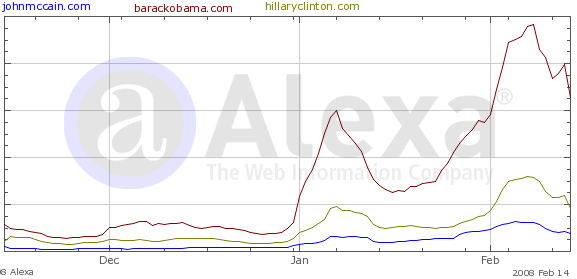
Campaign Website Traffic

The Nation’s blog looks at website traffic at the remaining three major candidates over the past three months. It shows a huge increase in Obama’s website traffic since the primary season heated up, a modest increase at Clinton’s site, but hardly any bump in McCain’s traffic.

Curiosity may explain party of the disparity–Obama is a relative newcomer to the national stage while Clinton and McCain are largely known quantities. Another explanation:

“I wouldn’t expect any bump in online traffic or activity for McCain. He won the nomination on the backs of moderates and independents. Moderates and independents don’t spend any time online obsessing about politics,” explained Conn Carroll, a blogger for The Heritage Foundation, a conservative non-partisan think tank. Carroll, who tracked web politics for The Hotline’s blogometer, contrasted McCain’s web drought to Ron Paul, the libertarian long tail candidate who raised tons of money online but never built a large coalition.

There’s probably something to this. McCain is, to some extent, a default front runner and doesn’t have the support of a large, ideological core group of supporters.
On the other hand, The Nation points out that in his 2000 presidential bid McCain had a strong web presence. It’s therefore odd that his effort this time around has fallen flat even though his campaign has thus far been a success.

Superdelegates, Obama/Bloomberg, Clinton’s Campaign

  • There’s been endless TV chatter regarding who Democratic superdelegates should vote for in the Clinton/Obama nomination battle.
    I agree that generally speaking the superdelegates should support the candidate that gets the most votes in the primaries. However, there is no requirement–as some have suggested–that the superdelegates vote in accordance with the primary results in his or her home district. If that’s a rule then there’s no reason to have superdelegates. We just need regular delegates.
    The reason superdelegates exist is to override voters in extreme cases when the party machinery determines voters have chosen a bad candidate. That being the case, most of this “horse race” tracking of superdelegates seems premature and misplaced. For now, we should be focusing on the committed delegates. If it gets to the point where superdelegates necessarily come into play (i.e., a convention fight), we’ll deal with it then.
  • This is one of the more fanciful things I’ve read today:

    The word on the street is that the Obama campaign and New York Mayor Mike Bloomberg have already met and devised an incredible plan if Clinton wins the nominee. Mayor Bloomberg would give nearly $1 billion to Obama’s campaign after which Obama would bolt from the Democratic Party and run as an Independent candidate with king-maker Bloomberg as his running mate. The Obama campaign realizes that Obama is too new at this game and doesn’t have the political weight of the Clintons to bring in the true heavy-hitters of the party’s hierarchy.  So, according to sources it was Bloomberg himself who suggested this cunning strategy. It’s mind boggling that the Clintons are willing to destroy the entire Democratic Party, and potentially in the process lose the White House and seats in Congress, for their own selfish thirst for power and glory.

    If Bloomberg doesn’t want to self-finance his own run, why would he pay to be someone else’s running mate? $1 billion, no less. I know the man has a lot of money, but who would pay $1 billion for that?
    An illustration of great sourcing there–“the word on the street,” whatever that means. Apparently it’s solid enough rumoring to be repeated to hundreds of thousands of listeners on right-wing radio.

  • I agree that a necessary prerequisite for Senator Clinton’s claim that she is ready to lead on “day one” is for her to run a good campaign. Thus far the evidence for that is mixed at best. I’m baffled how a campaign which is spending $10s of millions has, according to reports, failed to map out an effective strategy to win a majority of delegates in a must-win state.

Workplace Religious Freedom Act of 2007

Next Tuesday the U.S. House Subcommittee on Health, Employment, Labor, and Pensions is scheduled to hold hearings on the Workplace Religious Freedom Act of 2007 ( H. R. 1431).
This important legislation promotes the free exercise of religion by strengthening workplace protection of employee’s right to follow his or her religious beliefs. Specifically, it amends Title VII of the Civil Rights Act of 1964 to require that employers “reasonably accommodate” employee’s religious practices, so long as this does not create an “undue hardship” for the employer.
The North American Religious Liberty Association has a nice information pack on the WRFA (.pdf). Of note, the pamphlet sites a disturbing U.S. Equal Employment Opportunity Commission report that between 1993 and 2003, workplace claims of religious discrimination shot up 82%.
You can send letters in support of this bill to your Representative and Senators by filling out a form here.
UPDATE: In response to my letter (submitted at the above website) Senator Corker’s office e-mails, in part:

I agree with you that religious freedom is a fundamental American right and that no American worker should be discriminated against because of their religious beliefs. I look forward to reviewing this legislation, and, should it come before the full Senate, I will certainly take your thoughts on this issue into consideration.

I’ve not yet received a response from Senator Alexander or Representative Duncan.

Promises, Promises

Back in 2004, President Bush promised a five-year plan to cut the federal deficit in half by 2009. From his 2004 State of the Union Address (emphasis added):

In two weeks, I will send you a budget that funds the war, protects the homeland, and meets important domestic needs, while limiting the growth in discretionary spending to less than 4 percent. (Applause.) This will require that Congress focus on priorities, cut wasteful spending, and be wise with the people’s money. By doing so, we can cut the deficit in half over the next five years.

Federal deficit in 2004: $412.7 billion.
Flash forward to an AP story yesterday:

Slumping revenues and the cost of an economic rescue package will combine to produce a huge jump in the deficit to $410 billion this year and $407 billion in 2009, the White House says, just shy of the record $413 billion set four years ago.
But even those figures are optimistic since they depend on rosy economic forecasts and leave out the full costs of the war in Iraq. The White House predicts the economy will grow at a 2.7 percent clip this year, far higher than congressional and private economists expect, and the administration’s $70 billion figure for military operations in Iraq and Afghanistan is simply a placeholder until the next president takes office.

It seems we’ve got some fuzzy math here. $410 billion is 50% of $412.7 billion? I’m no math major, but that just doesn’t compute.
It’s true that last year’s deficit did fall below the 50% threshold. But according to these most recent projections, it appears that was a one year phenomenon. The deficit problem clearly hasn’t been fixed. It’s simply being passed on to the next administration.
Meanwhile, the coming fiscal Medicare/Medicaid meltdown is now four years closer . . . .

Shell Oil Hints At Peak Oil

This (via The Oil Drum) is noteworthy. In a recently-released statement, Royal Dutch Shell’s CEO all but admitted that the world is on the verge of peak oil prodution (emphasis added):

Regardless of which route we choose, the world’s current predicament limits our room to maneuver. We are experiencing a step-change in the growth rate of energy demand due to rising population and economic development. After 2015, easily accessible supplies of oil and gas probably will no longer keep up with demand.
As a result, we will have no choice but to add other sources of energy – renewables, yes, but also more nuclear power and unconventional fossil fuels such as oil sands.

It’s remarkable that a major energy company is publicly acknowledging that within seven years we will no longer be able to draw from “easily accessible”–i.e., “cheap”–reserves of oil. Presumably we’ll be stuck with drilling thousands of feet into the ocean or trying to squeeze oil out of sand. High demand for a resource + higher production costs = a much higher market price.
We now have energy company leaders talking about the upcoming oil supply crunch. Where is the political leadership on this issue?
Even the Democratic presidential candidates are missing in action. Sure they talk about more ethanol, changing light bulbs, and throwing up a few more windmills. But this problem calls for action far beyond that. We need to be restructuring our entire transportation system–placing a heavy emphasis on public transportation. We need to improve our rail infrastructure so that it will be better equipped to transport freight. We need to build or extend light (electric) rail transit systems in our major cities. We need to increase our nuclear power capacity.
In short, we need someone with leadership skills who can lead us in finding national solutions which may not necessarily be easy, convenient, or cheap. But which, over the long run, with help us navigate through the treacherous rapids of peak oil without capsizing.