
Here’s an interesting 1955 film (two parts) on a British cycling club taking a day tour in the English countryside.
Part One
Part Two
I like how the narrator points out that many people, “especially cyclists,” eat lots of food during such an excursion. I can relate to that!
While the film’s cyclists (and their bikes) are different than today’s spandex-clad road warriors, the enjoyment both groups share transcends time.
Tuesday Flower Blogging

A nearby, unidentified flower.
Mapping Cycing Routes
One of the interesting tools to emerge for geeky bicyclists during the past few years is mapping technology. This allows users to chart a route on a map in order to obtain distance, elevation, and other information about the ride. It also lets you share a course with other people.
Standalone mapping software has been out for a number of years. But in last couple years several free websites have been launched, bringing the technology to all Internet users. Among these are:
Map It Pronto
Gmap Pedometer
Bikely
Routeslip
Map My Ride
Using the latter, here’s the ride I did Sunday:
In short, I started near Heritage High School, followed the Little River to Walland, took Walden’s Creek Road to Pigeon Forge, looped around Bluff Mountain, and returned on the north side. It’s a scenic, somewhat hilly ride. The map claims there are 6,097ft of climbing on the route. I think that due to topographical ground noise (or whatever) that figure is significantly overestimated. I suspect the actual number is somewhere in the 3,000 to 4,000 ft range. At any rate, it’s enough to give your legs a workout.
I intended to cap the ride off with a climb up the Foothills Parkway. But by the time I finished the above loop it was late enough that darkness was becoming a factor. Plus I wasn’t feeling too energetic. So I wimped out and opted for a few more miles along the Little River. All told I logged 54 sunny miles Sunday afternoon–an outstanding ending to the weekend.
3-State 3-Mountain Challenge
Saturday I did my second consecutive 3S3MC. Here’s how it went.
The day started dark and early at 4:15 a.m. I ate an energy breakfast, loaded the car, and headed out at 5:30 a.m.
My big concern going into the event was the weather. The forecast said there was an 80% chance of thunderstorms. I encountered light rain much of the drive down. When I got 25 miles from Chattanooga, it started pouring.
“Oh, great,” I thought, “How bad do I want to do this ride?”
At that point the issue seemed to be not if I would get rained on, but rather how much I would get rained on.
But fortunately the precipitation eased up when I got to Hamilton County. By the time I arrived downtown, the rain had stopped altogether. It started sprinkling again for a few minutes when the ride started, but after that it stayed dry for the rest of the day. I don’t like riding in the rain, so I was very relieved.
Upon arrival, I picked up my registration packet, changed, and prepared to ride. The convoy of 2,400 cyclists had already started rolling by the time I was ready. I eased my way into the herd and began rolling. But a couple blocks later, I realized I had forgotten to affix the registration number to my bike. So I peeled off to the side went back to the car to get it.
I must have been toward the back of the pack by the time I restarted. Perhaps because of this, the first two or three miles were really slow. Due to the congestion, I didn’t got much above 10 mph as we rolled through downtown, up the highway ramp, and over bridge across the Tennessee River. It wasn’t until a mile or so later that I finally had enough space to ride at my own pace.
After a few miles of easy riding along the river, we hit Suck Creek Mountain. According to the route description, it’s a five mile climb with a 4-6% grade. It’s really not bad; it feels like you are climbing a really long hill rather than a mountain. I guess climbing is relatively one of my strengths, because I overtook at least 80% of the riders I passed while going uphill. On Suck Creek, I found a steady rhythm at 10-11 mph and stayed in the passing lane.
After the somewhat harrowing descent off Suck Creek Mountain, I passed the first rest stop. Since it was really crowded and I didn’t need anything, I skipped it. The next 30 miles was an enjoyable section of smooth sailing across the Tennessee Valley. I’m not used to ridding such long stretches of flat road, so it was fun cruising along at 20+ mph.
Forty-two miles into the ride I made my first stop at the Marion County rest stop. An overnight downpour and heavy foot traffic had converted the food area into a mud hole, which my cleats still haven’t recovered from. I gobbled down two peanut butter and jelly sandwiches, fig newtons, and fruit. My fuel supply replenished, I headed on to the second state and mountain.
You don’t need to see the sign to know when you enter Alabama–the road tells you. Chipseal! I rode near the center line, where it was smoothest, but it’s still rough. I was glad I wasn’t on an aluminum bike.
After being jarred about for three miles I made the turn and proceeded to Sand Mountain. It’s a steeper climb: “2.5 miles at a 6-7% grade.” A couple switchbacks near the end are even steeper. Several times my rear wheel lost traction as I was toiling upward. I’m not sure if the wet road surface or my worn tire was to blame. At any rate, the climb is bad enough–it’s no fun losing power.
There’s a great overlook atop Sand Mountain which offers a scenic view on clear days. No such reward for this climb–overcast conditions obscured the valley below. So instead of enjoying the horizon, I simply enjoyed clearing the sweat from my face.
The next section of route is lightly rolling, first on Sand Mountain and then as you continue into Georgia. I took my second and last food stop at the Alabama rest area. Then I stopped again at the 80 mile rest area to rehydrate and prepare for the challenge.
Less than a mile after the stop you make an abrupt left turn and there it is: Burkhalter Gap. The first 2 miles of the mountain is a 8-10% grade. Unlike some climbs, the first mile or so if this one is fairly straight. So you can look ahead and see what looks like a long death march toward the sky.
Once you get through the base section, the climb eases up for a short stretch, just enough for you to start catching you breath. Then you go around a curve and crash against the wall: a 250-yard long piece of 14-17% grade at the top. I down shifted to my lowest gear and marshaled all available power to clear that hurdle.
After a cool down at the top, I tackled the home leg. One is tempted to think that your work is done once you conquer Burkhalter Gap. But in reality there’s still a few miles of rollers along Lookout Mountain. Fortunately none of them are very long so I was able to power through them without doing major damage.
At last I made it to the descent off Lookout Mountain. No more climbing! There was a little more traffic than I like to see on a curvy descent, but the drivers behind me were patient.
At the bottom of the mountain, traffic directors were stationed at intersections to give cyclists the right of way. But they succeeded in backing up traffic, thus making it difficult to navigate the aforementioned intersections. Oh well, the thought was nice.
I rolled through the finish line a little before 4:00 p.m., tired but happy. I did the ride in about 10 less minutes of riding than 2006. After changing, I relaxed for a while and downed six large pieces of pizza. Six hours of cycling can really stoke one’s appetite.
All in all, another great century. Nice scenery, good roads (except Alabama), a unique and varied course, and well-stocked rest stops. I hope to do it again. Thanks to the organizers and volunteers who ran the event.
Ride Statistics
Distance: 100.2 miles
Riding time: 6:09
Average speed: 16.1 mph
Post-ride photo:
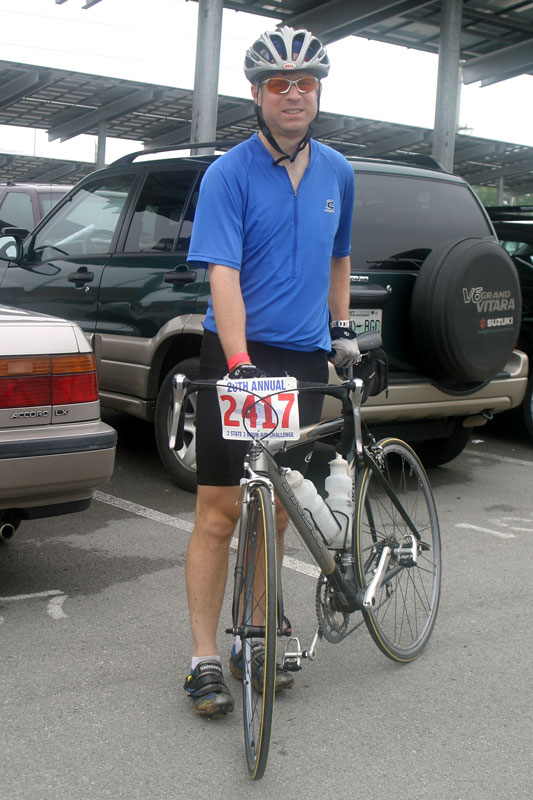
See also Chattanooga Times Free Press, Bike Forums ride thread (I’m Velo Vol).
GOP Debate
I watched part of the GOP presidential debate last night.
Clearly, ten candidates is way too many participants for a general issue debate. The organizers should either split the field in half and have two debates (not a practical solution) or they should limit the issues (e.g., a foreign policy debate) so the candidates can offer more substance.
This is pretty funny:
President Bush’s name was invoked by Republican candidates only once during yesterday’s 90-minute debate, in response to a question about Scooter Libby’s pardon. By comparison, Ronald Reagan’s name was cited 19 times.
The Bush record was the elephant in the room, so to speak.
I thought the moderators had a few interesting questions which got at the big-government conservative/libertarian divide. I also think the show of hand questions can be used as an effective change of pace. But note to moderator: if you are going to ask for a show of hands, take the time to acknowledge who is raising his hand. It’s pointless exercise if viewers don’t get to see who has his hand shot. A two second side view of the candidates doesn’t cut it (this happened in the Democratic debate, too).
Speaking of pointless, how was this Chris Mathews question:
But let me ask you about something else that might be a negative in the upcoming campaign. Seriously.
Would it be good for America to have Bill Clinton back living in the White House?
A stupid and loaded (“negative”) question. What a waste of our time with that silliness. A GOP candidate would just as soon burn an American flag on stage as answer “yes” to that question. What’s the point of asking? How is that supposed to enlighten the audience on the candidates’ philosphy?
Street Fight
In case you’ve missed it, MSNBC is televising a Republican presidential debate tonight. (They’ve got a nifty debate countdown clock to remind you, lest eleven hours of pre-debate coverage isn’t enough.)
Yesterday, Chris Matthews was warming up for his big role as debate moderator. Here he asks Rudy Giuliani’s campaign manager and Mit Romney’s campaign spokesperson the question on every voter’s mind:
MATTHEWS: Who would win a street fight? Rudy Giuliani–just think of a street fight now over in Queens somewhere. It is a dark night, it is about 2:00 in the morning. Two guys are out behind the building, right? On a vacant lot. Rudy Giuliani or President Ahmadinejad, who would win that fight?
. . .
MATTHEWS: If he wins that notion, he is the next president. That is one to look for. Who is tougher than Ahmadinejad, because he is our biggest worry right now.
. . .
MATTHEWS: I want to ask you this, do you think Romney has got–can he take the–roll up the sleeves and get out there and have a street fight with Ahmadinejad? Is he tough enough to beat Rudy at that notion of being tough?
GINSBERG: Well, he would never fight Rudy. Yes, he is tough enough to win the fight with the foreign leader, sure. Because he is a man of principle and a man of intellect.
MATTHEWS: Can’t you pronounce the name Ahmadinejad?
GINSBERG: I can most of the time. But not all of the time.
Yes, if there is one issue all voters hold in common, it’s the 2 a.m. street fight question. Given the frequency that world leaders meet in back alleys, America needs a tough fighter. That’s why the Draft Mike Tyson for President movement is gaining such traction.
Journalism at its finest.